Timeline Og Baby Boomers Genx Melleniald Gen Z
For decades, Pew Research Center has been committed to measuring public attitudes on key bug and documenting differences in those attitudes across demographic groups. One lens ofttimes employed by researchers at the Middle to empathise these differences is that of generation.
Generations provide the opportunity to look at Americans both by their identify in the life cycle – whether a young adult, a middle-aged parent or a retiree – and past their membership in a accomplice of individuals who were born at a similar time.

As we've examined in by work, generational cohorts give researchers a tool to analyze changes in views over time. They tin provide a manner to understand how different formative experiences (such as world events and technological, economic and social shifts) interact with the life-bike and aging procedure to shape people's views of the world. While younger and older adults may differ in their views at a given moment, generational cohorts let researchers to examine how today's older adults felt virtually a given issue when they themselves were young, as well as to depict how the trajectory of views might differ across generations.
Pew Research Eye has been studying the Millennial generation for more than a decade. But by 2018, it became clear to the states that it was time to determine a cutoff point between Millennials and the side by side generation. Turning 38 this year, the oldest Millennials are well into adulthood, and they first entered machismo before today'southward youngest adults were born.
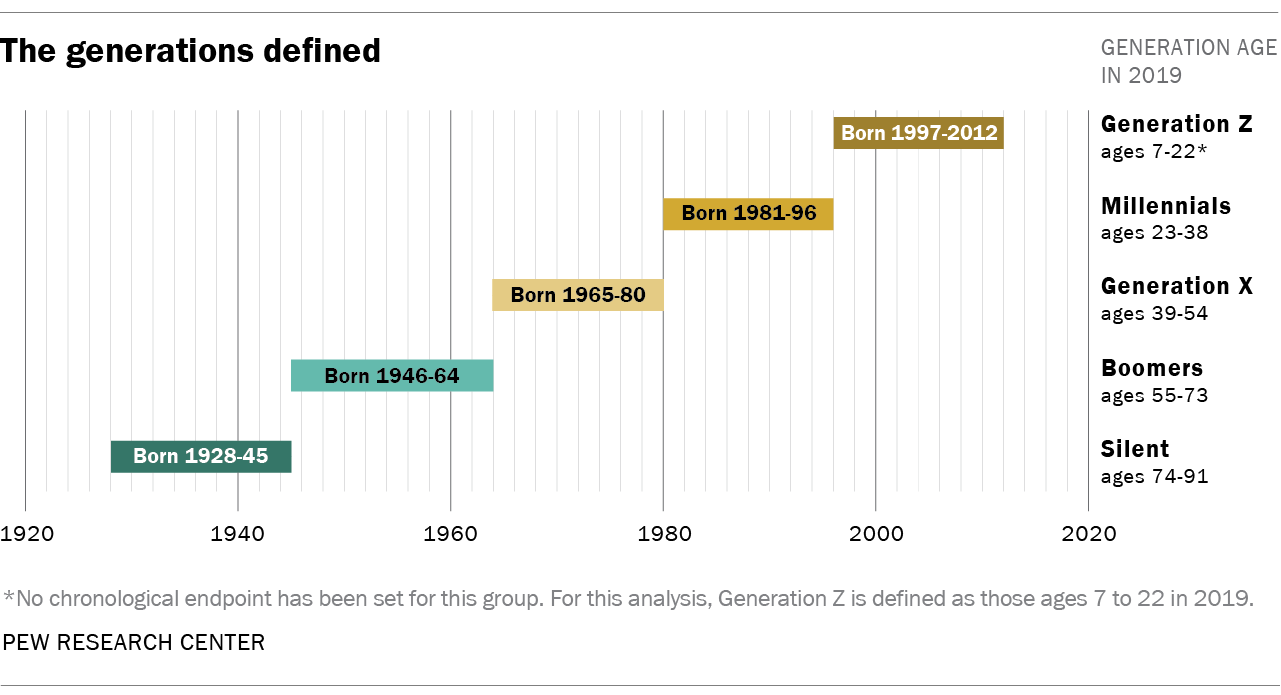
In order to keep the Millennial generation analytically meaningful, and to begin looking at what might be unique about the side by side accomplice, Pew Research Centre decided a year ago to apply 1996 as the terminal birth year for Millennials for our futurity work. Anyone born between 1981 and 1996 (ages 23 to 38 in 2019) is considered a Millennial, and anyone born from 1997 onward is part of a new generation.
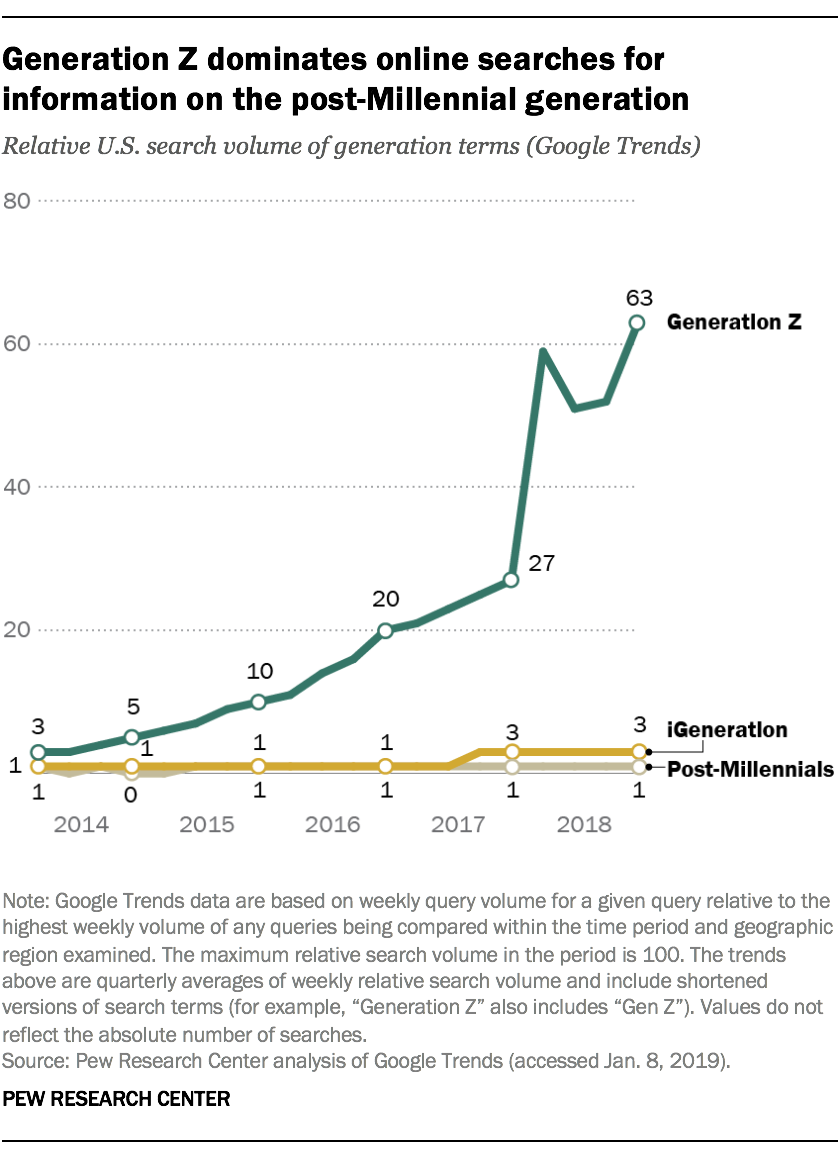
Since the oldest among this ascent generation are just turning 22 this year, and most are still in their teens or younger, we hesitated at commencement to give them a proper noun – Generation Z, the iGeneration and Homelanders were some early candidates. (In our outset in-depth look at this generation, we used the term "postal service-Millennials" as a placeholder.) But over the by year, Gen Z has taken concur in popular culture and journalism. Sources ranging from Merriam-Webster and Oxford to the Urban Lexicon now include this name for the generation that follows Millennials, and Google Trends data show that "Generation Z" is far outpacing other names in people's searches for information. While at that place is no scientific process for deciding when a name has stuck, the momentum is conspicuously behind Gen Z.
Generational cutoff points aren't an verbal science. They should exist viewed primarily as tools, allowing for the kinds of analyses detailed to a higher place. But their boundaries are non arbitrary. Generations are often considered past their span, but again there is no agreed upon formula for how long that span should exist. At 16 years (1981 to 1996), our working definition of Millennials is equivalent in age span to their preceding generation, Generation Ten (born between 1965 and 1980). By this definition, both are shorter than the span of the Baby Boomers (nineteen years) – the only generation officially designated past the U.S. Census Bureau, based on the famous surge in post-WWII births in 1946 and a pregnant decline in birthrates afterward 1964.
Dissimilar the Boomers, in that location are no comparably definitive thresholds by which later generational boundaries are divers. Only for belittling purposes, we believe 1996 is a meaningful cutoff betwixt Millennials and Gen Z for a number of reasons, including fundamental political, economic and social factors that define the Millennial generation'southward formative years.
Most Millennials were between the ages of v and 20 when the 9/eleven terrorist attacks shook the nation, and many were old plenty to comprehend the historical significance of that moment, while virtually members of Gen Z have little or no retentivity of the upshot. Millennials also grew up in the shadow of the wars in Iraq and Afghanistan, which sharpened broader views of the parties and contributed to the intense political polarization that shapes the current political environment. And near Millennials were between 12 and 27 during the 2008 election, where the force of the youth vote became part of the political conversation and helped elect the offset black president. Added to that is the fact that Millennials are the nearly racially and ethnically diverse adult generation in the nation's history. Yet the next generation – Generation Z – is even more diverse.
Across politics, most Millennials came of age and entered the workforce facing the height of an economic recession. Equally is well documented, many of Millennials' life choices, future earnings and entrance to adulthood have been shaped past this recession in a style that may non be the instance for their younger counterparts. The long-term effects of this "tedious first" for Millennials will exist a gene in American society for decades.
Engineering science, in item the rapid development of how people communicate and interact, is another generation-shaping consideration. Babe Boomers grew up as idiot box expanded dramatically, irresolute their lifestyles and connection to the world in fundamental ways. Generation X grew up as the reckoner revolution was taking hold, and Millennials came of age during the internet explosion.
In this progression, what is unique for Generation Z is that all of the higher up take been function of their lives from the start. The iPhone launched in 2007, when the oldest Gen Zers were x. By the time they were in their teens, the primary means past which young Americans connected with the web was through mobile devices, WiFi and loftier-bandwidth cellular service. Social media, constant connectivity and on-need entertainment and advice are innovations Millennials adapted to equally they came of historic period. For those born after 1996, these are largely assumed.
The implications of growing up in an "ever on" technological environment are only now coming into focus. Recent research has shown dramatic shifts in youth behaviors, attitudes and lifestyles – both positive and apropos – for those who came of historic period in this era. What we don't know is whether these are lasting generational imprints or characteristics of boyhood that will become more muted over the course of their adulthood. Beginning to runway this new generation over fourth dimension volition be of significant importance.
Pew Research Centre is non the showtime to draw an analytical line between Millennials and the generation to follow them, and many have offered well-reasoned arguments for drawing that line a few years before or later than where nosotros have. Possibly, equally more data are collected over the years, a clear, singular delineation will emerge. Nosotros remain open to recalibrating if that occurs. Simply more than likely the historical, technological, behavioral and attitudinal data will show more of a continuum across generations than a threshold. Equally has been the case in the by, this ways that the differences within generations can be just as great every bit the differences across generations, and the youngest and oldest inside a ordinarily defined cohort may feel more than in common with bordering generations than the one to which they are assigned. This is a reminder that generations themselves are inherently diverse and complex groups, not simple caricatures.
In the near term, you lot will run across a number of reports and analyses from the Centre that continue to build on our portfolio of generational research. Today, we issued a report looking – for the first time – at how members of Generation Z view some of the cardinal social and political issues facing the nation today and how their views compare with those of older generations. To be sure, the views of this generation are not fully formed and could change considerably equally they age and as national and global events intervene. Even so, this early look provides some compelling clues well-nigh how Gen Z volition aid shape the future political mural.
In the coming weeks, we will be releasing demographic analyses that compare Millennials to previous generations at the same stage in their life bicycle to see if the demographic, economic and household dynamics of Millennials continue to stand up apart from their predecessors. In addition, we will build on our research on teens' technology use by exploring the daily lives, aspirations and pressures today's 13- to 17-year-olds face every bit they navigate the teenage years.
Yet, we remain cautious well-nigh what can be projected onto a generation when they remain so young. Donald Trump may be the first U.S. president most Gen Zers know as they turn xviii, and just every bit the contrast between George Westward. Bush and Barack Obama shaped the political debate for Millennials, the current political environment may have a similar effect on the attitudes and engagement of Gen Z, though how remains a question. Every bit of import as today's news may seem, information technology is more than likely that the technologies, debates and events that volition shape Generation Z are even so nevertheless to exist known.
We wait forrad to spending the next few years studying this generation as it enters adulthood. All the while, we'll proceed in mind that generations are a lens through which to understand societal change, rather than a label with which to oversimplify differences between groups.
Annotation: This is an update of a post that was originally published March 1, 2018, to announce the Center'south adoption of 1996 as an endpoint to births in the Millennial generation.

Source: https://www.pewresearch.org/fact-tank/2019/01/17/where-millennials-end-and-generation-z-begins/
0 Response to "Timeline Og Baby Boomers Genx Melleniald Gen Z"
Postar um comentário