Uploading Canvas Outcomes Import Standards in Canvas
Skip to:
- content
- search
- login
Use Excel to create or modify outcomes in Canvass
On this page:
- Overview
- Create the outcomes framework in Sail
- Export the outcomes
- Edit the outcomes in Excel
- Import the CSV file into Sheet
Overview
Creating a large set of outcomes in the Canvas Outcomes tool for a department, school, campus, or programme can be very labor intensive. If yous are comfortable working in Microsoft Excel, you can speed things upward by creating or updating the outcomes data in Excel and importing the results into Canvas. This article explains how to create a skeletal outcomes construction in Canvas, export it to Excel, change the information, and import the results into the Outcomes tool. It's as well possible to create an entire outcomes set from scratch in Excel, only since pocket-sized errors can prevent the data from importing properly, this option is just recommended for advanced users. For more, see How exercise I import outcomes for an account? and Outcomes Import Format Documentation.
Annotation:
Completing the actions in this document requires administrative privileges in Canvass. For information on how to asking administrative access, see Authoritative access to Sail at IU.
Create the outcomes framework in Canvas
To create the skeletal framework in Sail:
- Create the parent group and subgroups.
- Add the starting time consequence to the group or appropriate subgroup. In addition to inbound the proper noun and description, fix the rating scale, mastery level, and adding method to the values that will be used past all outcomes in the fix (for detailed instructions, see How do I create an outcome for an business relationship?)
- Create the remaining outcomes in the ready, adding them to the parent grouping or subgroups as appropriate. Practise not set the ratings scale, mastery level, or calculation method for these outcomes. You'll practice this later by copying and pasting this data in Excel.
Export the outcomes
One time the skeletal framework is complete, export it to a CSV file:
- Log into Sheet and navigate to the administrative account containing your outcomes set.
- In the account navigation menu, click .
- In the Settings tool, click to view the reports available in the account.
- Locate the written report named "Outcomes Consign", and click .
- It may accept a minute or two for the study to be generated. Refresh the settings tool and return to the tab. When your report is available, you lot should see today'southward date and a download link for the written report like to the screenshot below:

- Click the download icon to salve the CSV file to a local bulldoze or cloud storage service.
Edit the outcomes in Excel
Note:
When editing an exported CSV file or creating an import file from scratch, note the following requirements:
- Parent outcome groups must precede child groups.
- Outcome groups must precede outcomes.
- The value in the "vendor_guid" column must be unique.
- In the "vendor_guid" column, only values created in Canvass via the user interface should begin with the prefix
canvas_outcome:orcanvas_outcome_group:. If you want to add together a new outcome or group to the CSV file, the value of the "vendor_guid" cavalcade should not utilise the prefix.
- Open the CSV file in Microsoft Excel.
- The first row contains the cavalcade headings. Never change the values in this row. Descriptions of the purpose and requirements for each column are available in Outcomes Import Format Documentation.
- The data describes two dissimilar object types, groups and outcomes. The type is designated in column B. Y'all will exist primarily concerned with the rows containing outcomes, not groups.
- Locate the row in the file for the showtime outcome you created in the set--that is, the one with the right rating calibration, mastery level, and adding method. Select the data in columns F ("calculation_method") and Thousand ("calculation_int") of this row and copy the data to the clipboard.

- Select column F in the other outcomes in the set and paste the information from the clipboard. Be sure not to paste into rows that correspond groups and/or rows for outcomes that belong to other sets.
- Return to the row for the first outcome y'all created, and select the data in columns J ("mastery_points"), 50 ("ratings"), and all columns to the right of L containing rating scores or descriptions.
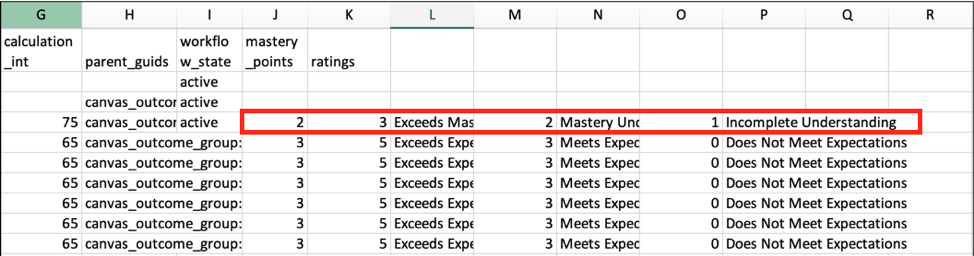
- Select cavalcade J in the other outcomes in the set and paste the data from the clipboard. If the pasted rating calibration has fewer values than the original scale for those rows, delete the extra values and their labels. (They will announced to the right of the label for the smallest value in the pasted scale.)
All of the outcomes in the CSV file should at present have identical values for columns F, Thou, J, Yard, and columns to the right of Thousand containing rating scale values and labels.
- Save the CSV file.
Import the CSV file into Sheet
- Return to Sheet and navigate to the Outcomes tool in your unit's account.
- Click . And then use drag and driblet or browse to upload the CSV file into the Outcomes tool. When the import has completed, you'll be notified both on screen and via electronic mail. If whatever errors were encountered, the email notification will provide details.
Related documents
This is document awbc in the Knowledge Base.
Last modified on 2021-09-21 15:34:50 .
Source: https://kb.iu.edu/d/awbc
0 Response to "Uploading Canvas Outcomes Import Standards in Canvas"
Postar um comentário